
Fincen State Mtl Fintrac Msb Regimes
Agent of the Payee Exemption: 50-State Marketplace, SaaS & Bill-Pay Settlement Analysis
Properly structured, the statutory Agent of the Payee (AoP) exemption lets e-commerce marketplaces, vertical SaaS platforms, and billers settle billions without holding 49 state MTLs.
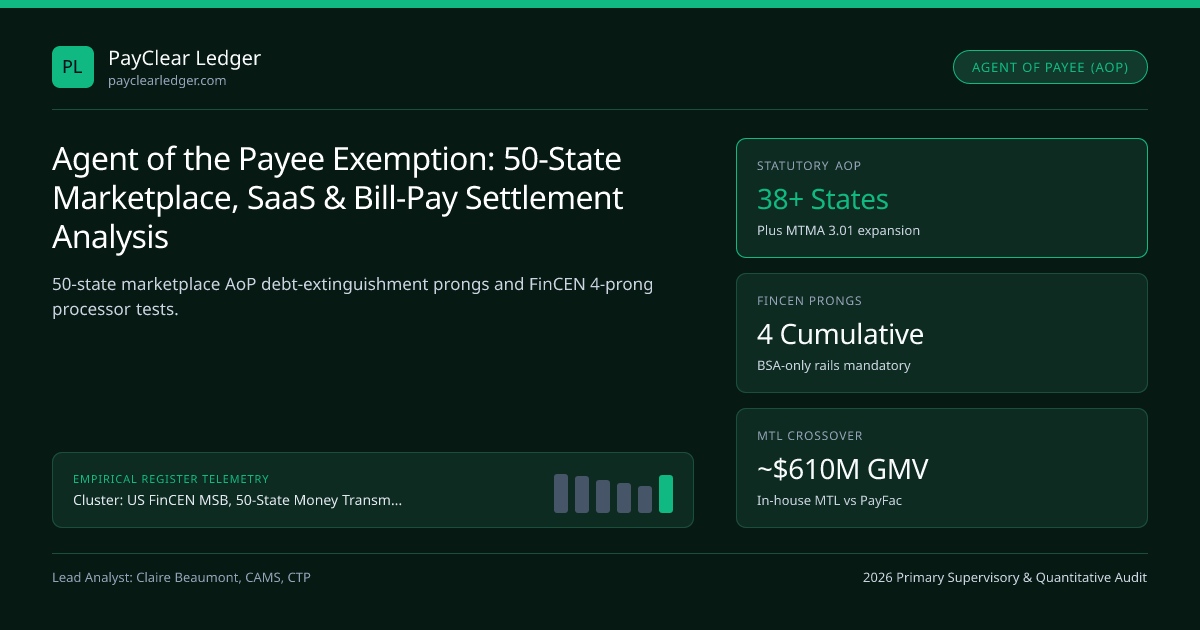
How do major e-commerce marketplaces, vertical B2B SaaS platforms, property-management rent portals, and healthcare billing suites collect billions of dollars from buyers and disburse net payouts to sellers—often before obtaining 49 Money Transmitter Licenses? They rely on two narrow legal pillars: federal FinCEN’s Integral Payment Processor Exemption (31 CFR § 1010.100(ff)(5)(ii)(B)) and state law’s Agent of the Payee (AoP) Exemption. Yet a single flawed contract clause, buyer wallet feature, or unmapped "holdout state" turns a supposedly exempt SaaS platform into an unlicensed felony money transmitter overnight!
The Two Non-Negotiable Statutory Prongs of Agent of the Payee (AoP)#
Pioneered by New York, California (`CFC § 2010(l)`), and Texas, and now enacted across 38+ states (dramatically expanded by Section 3.01(c) of CSBS’s Model Money Transmission Modernization Act), the statutory Agent of the Payee exemption shields an intermediary receiving money from a Payer (buyer/tenant/patient) for transmission to a Payee (merchant/landlord/clinic) ONLY IF BOTH prongs hold true: (1) Pre-Existing Written Agency Agreement: a written contract between the Payee and the Platform explicitly appoints the Platform as the Payee’s limited payment-collection agent for the sale of goods or services (other than money transmission itself!); and (2) Immediate Debt Extinguishment ("Delivery to Agent = Delivery to Principal"): the contract explicitly stipulates that payment by the Payer to the Agent immediately satisfies and extinguishes the Payer’s payment obligation to the Payee, shifting 100% of Platform insolvency/non-delivery risk onto the Payee—NEVER the consumer Payer!
See how AoP fits within the complete regulatory decision tree in our US FinCEN MSB, 50-state MTL & Canada FINTRAC guide.
Federal Parallel: FinCEN’s 4-Prong Payment Processor Exemption (FIN-2014-R009)#
Remember: state AoP does NOT automatically exempt you from federal FinCEN Form 107 MSB registration! To qualify for FinCEN’s federal Payment Processor Exemption (31 CFR § 1010.100(ff)(5)(ii)(B) & FIN-2013-G002), the platform must satisfy all four cumulative conditions: (1) the entity facilitates the purchase of goods or services or payment of bills for a creditor/seller (not mere P2P transfers), (2) it operates exclusively through clearance and settlement systems that admit only BSA-regulated institutions (e.g., ACH, Fedwire, FedNow, Visa/Mastercard via banks like Barclays or Goldman Sachs—settling merchant payouts in crypto/USDC immediately destroys Prong 2!), (3) it acts pursuant to a formal written agreement with the seller/creditor, and (4) it receives payment from the debtor on behalf of the seller.
Mapping the Remaining Holdout States & Fatal Product Anti-Patterns#
Even in 2026, roughly 8–10 states still lack an explicit statutory AoP clause (or require formal no-action opinion letters—historically states such as Connecticut, Missouri, Alabama, or New Jersey depending on legislative session updates), which is why platforms like Stripe Connect, Adyen for Platforms, or FBO bank-sponsored BaaS engines route funds through a licensed MTL subsidiary or chartered bank rather than relying nakedly on 50-state AoP!
Even inside explicit AoP states (CA, NY, TX, WA, IL), four product features instantly destroy AoP protection: (a) Buyer Stored-Value Wallets (holding refund credits or prepaid top-ups before a specific merchant purchase exists), (b) Agent of the Payer ("bill-pay apps" hired by consumers to pay unaffiliated utilities/landlords who never signed an agency contract with the app!), (c) Multi-Hop Split Payouts to Uncontracted Third Parties (paying sub-contractors who aren’t the contracted Payee of the buyer), and (d) Charitable Donations where no "goods or services" were exchanged (unless covered by a state charity exemption).
| Platform / Flow Pattern | Qualifies for State AoP? | Qualifies for FinCEN Processor? | Why It Passes or Fails | Compliant Production Fix |
|---|---|---|---|---|
B2B SaaS Invoicing (Seller Contracted, ACH/Card) | Yes (in 38+ statutory AoP states) | Yes (all 4 prongs met) | Written payee contract + debt extinguished + BSA rails only | Pair AoP ToS with PayFac/FBO in remaining non-AoP states |
Consumer Bill-Pay App (Paying Unaffiliated Landlords) | NO (Agent of the Payer!) | NO (Lacks creditor contract) | Landlord never appointed app; tenant still owes rent if app fails | Requires full 49-state MTLs + FinCEN Form 107 (or licensed sponsor) |
| Marketplace Buyer "Store Credit / Wallet Balance" | NO (Stored Value Issuance) | NO (Pre-purchase open float) | Holding unspent buyer cash before selecting a seller = stored value | Eliminate pre-funded wallets or house balances in bank FBO / MTL |
Marketplace Settling Seller Payouts in USDC | Fails in WA / NY / CA DFAL | NO (Fails BSA-only rail prong!) | Blockchain rails are not BSA-regulated-only clearing systems | Execute fiat settlement first or route USDC leg via licensed MSB/Trust |
Multi-Tier Revenue Split (Paying Uncontracted Tip/Sub) | NO (Missing Direct Payee Link) | Risk of failing Prong 3/4 | Buyer owed Seller A, not Sub-Contractor B | Contract every split recipient directly as co-payee on buyer checkout |
Hybrid Architecture: Pairing AoP Terms With Licensed PSP / FBO Rails#
Institutional marketplace counsel pair ironclad AoP Terms of Service (protecting the SaaS platform) with licensed payment-facilitator (PayFac) / Stripe Connect / FBO bank rails (covering non-AoP holdout states and card-network PayFac rules under Visa/Mastercard). Compare full MTL buildout economics in our build-vs-buy 50-state MTL TCO model, check float carry in our Nostro SOFR prefunding carry calculator, and browse the FinCEN & State MTL topic hub.
Marketplace Payment Take-Rate Margin Comparison: Naked AoP vs PayFac vs Own MTLs#
Choosing between embedding Stripe Connect / PayFac-as-a-Service (fast 50-state coverage, 15–35 bps platform take-rate cost) versus obtaining your own 49-state MTLs (fixed ~$990K/yr compliance overhead, 0 bps variable licensing rent) depends directly on Gross Merchandise Volume (GMV).
Below is the marketplace payment architecture margin equation.
- Where:
- Cannual49state_mtl = Annual 49-state MTL compliance, bonds, exams & BSA staffing (USD 990,000/yr)
- AmortizedBuild5yr = USD 1,650,000 upfront legal/application build / 5 years = USD 330,000/yr
- fmanaged - fdirect = Managed Connect/PayFac platform fee (24 bps) - Direct ACH/Card PayFac ops (6 bps) = 18 bps (0.0018)
- yfloatbps = Incremental 3-day payout float yield @ 4.50% SOFR (~3.7 bps = 0.00037)
- Worked Marketplace Licensing Crossover:
- GMV_Breakeven = (USD 990,000 + USD 330,000) / (0.0018 + 0.00037) = USD 1,320,000 / 0.00217 = USD 608.3M annual GMV
Frequently asked questions
Why does a consumer rent-payment app fail Agent of the Payee if the landlord hasn’t signed a contract?
Because if the tenant hires the app to mail a check or send an ACH to an unaffiliated landlord, the app is acting as the Agent of the Payer (the tenant). If the app goes bankrupt before paying, the landlord can still evict the tenant—triggering full MTL licensing across all 49 states.
What exact contract sentence do state examiners look for when auditing an AoP exemption claim?
Examiners verify explicit language in the Seller Agreement stating: "Seller appoints Platform as its limited payment collection agent solely for accepting funds from Buyers, and receipt of funds by Platform from Buyer constitutes receipt by Seller and extinguishes Buyer’s payment obligation."
Does qualifying for state Agent of the Payee automatically exempt us from Visa and Mastercard PayFac rules?
No. Card network Payment Facilitator (PayFac) registration and prohibiting aggregation/factoring are private contractual rules enforced by Visa, Mastercard, and acquiring banks—completely separate from state statutory MTL laws.
If we let marketplace buyers keep refunded money as "Platform Cash" for future orders, do we lose AoP?
Yes! Once an order is canceled and no specific contracted seller owes goods, holding unallocated dollar value redeemable across any future seller constitutes issuing "stored value," triggering state MTL and FinCEN prepaid/MSB rules.
Publication record
- Published
- November 13, 2026
- Updated
- November 14, 2026
- Author
- Claire Beaumont, CAMS, CTP
- Review
- Review not recorded
- Automated fact check
- Passed in the stored pipeline record
- Source URLs
- 3 recorded
AI assistance recorded: anthropic/claude-opus-4.6. This field does not establish human review or source verification.
Academic & Institutional Attribution
Cite This Research & Embed Live Data Card
Standard academic & institutional research paper citation format.
Claire Beaumont, CAMS, CTP. (2026, November 14). Agent of the Payee Exemption: 50-State Marketplace, SaaS & Bill-Pay Settlement Analysis. PayClear Ledger. https://payclearledger.com/rails/agent-of-the-payee-exemption-50-state-marketplace-payment-settlementRegulatory Directory Cross-Reference
Referenced Institutions & Regulatory Registries
Mentioned Regulated Institutions
Referenced Supervisory Authorities
Related Fincen State Mtl Fintrac Msb Regimes & Institutional Briefings
Explore Fincen State Mtl Fintrac Msb Regimes Hub (20) →Fincen State Mtl Fintrac Msb Regimes
US FinCEN MSB, 50-State Money Transmitter Licensing & Canada FINTRAC RPAA Institutional GuideFincen State Mtl Fintrac Msb Regimes
FBO ("For Benefit Of") Bank Sponsorship & BaaS Flow-of-Funds: Avoiding Constructive Custody & MTL RiskFincen State Mtl Fintrac Msb Regimes
FinCEN Form 109 MSB Suspicious Activity Reports ($2,000 Threshold) & Form 112 CTR Structuring ControlsFincen State Mtl Fintrac Msb Regimes
BSA Funds Travel Rule (31 CFR 1010.410(f)): USD 3,000 Transmittal Recordkeeping & Crypto VASP ComplianceFincen State Mtl Fintrac Msb Regimes
CFPB Remittance Transfer Rule (Reg E Subpart B): FX Pre-Disclosures, 30-Min Cancel & Error LiabilityFincen State Mtl Fintrac Msb Regimes
Canada FINTRAC MSB & Foreign MSB (FMSB) Registration: PCMLTFA Compliance & 24-Hour EFTR RulesFincen State Mtl Fintrac Msb Regimes
Bank of Canada Retail Payment Activities Act (RPAA): PSP Registration, Trust Safeguarding & Risk RulesFincen State Mtl Fintrac Msb Regimes
NMLS Quarterly Money Services Businesses Call Report (MSBCR): Schedules A–F State ReconciliationInstant Payment Rails Fednow Sepa Pix
India UPI–Singapore PayNow Bilateral Instant Linkage: VPA Proxy Routing, LRS Limits & FX SettlementInstant Payment Rails Fednow Sepa Pix
Brazil BCB Pix & SPI Architecture: Selic-Remunerated Conta PI, MED 2.0 Fraud Recovery & Pix InternacionalInstant Payment Rails Fednow Sepa Pix
FedNow & RTP Request for Payment (RfP): ISO 20022 pain.013 / pain.014 B2B Invoice SettlementInstant Payment Rails Fednow Sepa Pix
NACHA Same-Day ACH Settlement Windows ($1M Cap) vs FedNow & RTP Instant Payment Rails
PayClear Ledger Data, Benchmarks & Contributor Records
CC BY 4.0 Open Data
Open Institutional Datasets (CSV / JSON) →
Download desk-compiled quantitative series & schemas.
2026 Reference Matrix
2026 Institutional Benchmarks & Thresholds →
Statutory capital, clearing, margin & rate conventions.
Editorial Records
Authors & Review Records →
View named contributors where those records are available.
Complete Index
Master Research & Dossier Archive →
Browse all published briefings by topic pillar & date.